
When selecting an ECG electrode, healthcare professionals often focus on the backing material, connector, or electrode shape. However, one of the most important components is hidden beneath the electrode surface: the conductive gel.
The gel creates the electrical interface between the patient's skin and the electrode sensor. Its formulation and physical properties influence electrical contact, signal acquisition, moisture retention, and adhesion performance.
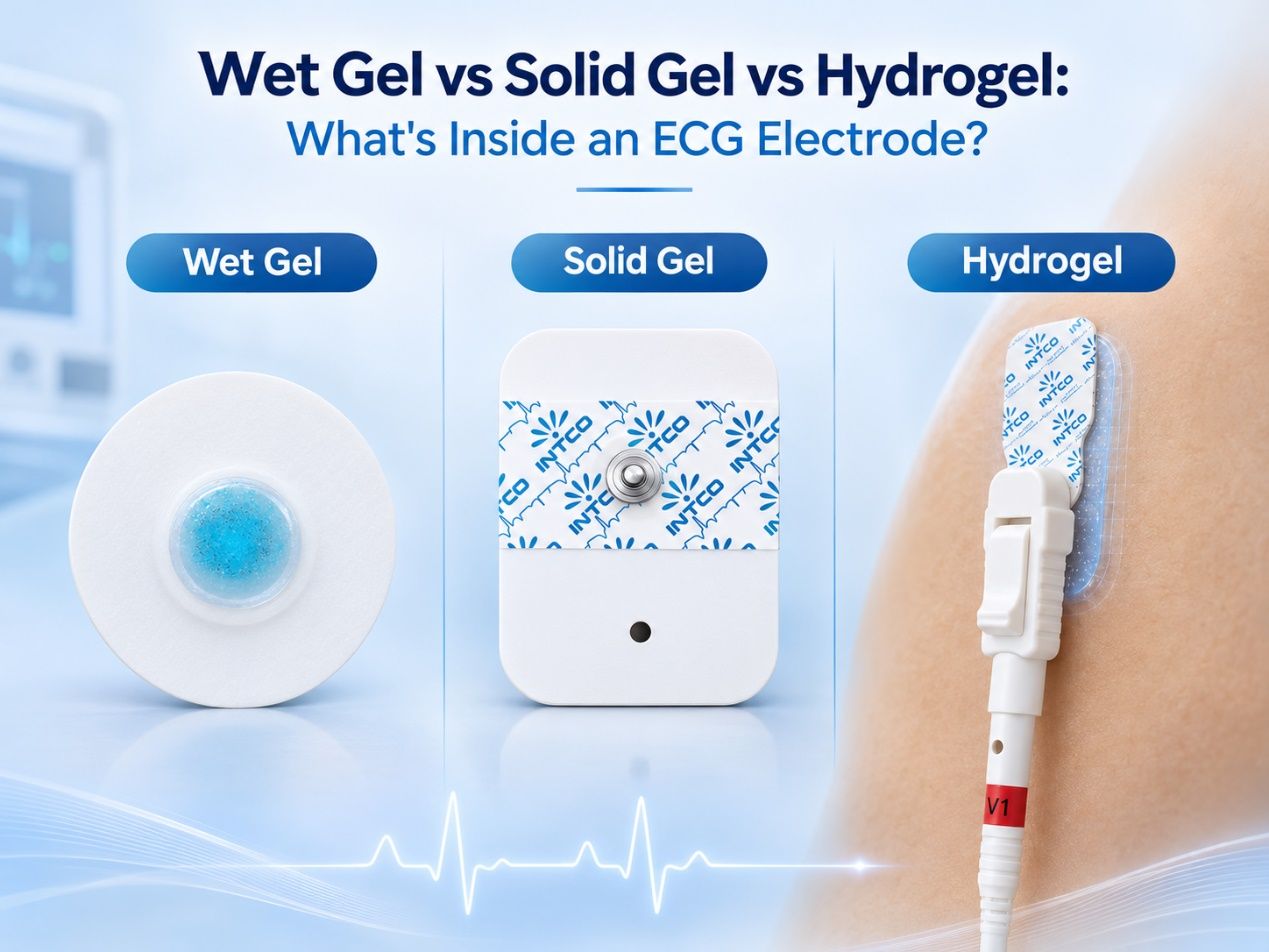
Wet gel, solid gel, and hydrogel are three commonly discussed terms in ECG electrode manufacturing. Although they share the same fundamental purpose, their material structures and application characteristics can differ.
This guide compares the three conductive gel types from a manufacturer's perspective, explains their impact on ECG signal quality and wear time, and helps clinical professionals and OEM buyers select the right electrode for different monitoring applications.
1. The Three Conductive Gel Types at a Glance
Conductive gel is an essential component of disposable ECG electrodes. It facilitates ionic conduction between the skin and the electrode's conductive sensing element, commonly made of silver/silver chloride (Ag/AgCl).
However, not all conductive gels have the same physical structure or adhesive properties.
Wet Gel vs Solid Gel vs Hydrogel: Key Differences
| Comparison | Wet Gel | Solid (Adhesive) Gel | Hydrogel |
|---|---|---|---|
| Material Structure | Water-based electrolyte gel, often soft or fluid | Semi-solid conductive adhesive formulation | Water-containing polymer network with electrolyte |
| Moisture | Relatively high mobile water content | Water retained within a structured gel matrix | Water retained within a polymer network |
| Adhesion Mechanism | Usually works with a separate adhesive layer | Conductive gel itself can contribute to adhesion | Depends on polymer formulation; may provide conductive and adhesive functions |
| Electrical Contact | Supports rapid skin wetting and electrical contact | Designed for consistent electrical contact and integrated adhesion | Can provide conformal skin contact and ionic conduction |
| Drying Behavior | Can lose moisture when exposed to air | Depends on formulation and packaging | Can also lose moisture through evaporation |
| Common Applications | Diagnostic ECG, emergency care, stress testing | Patient monitoring and long-term monitoring products | Medical monitoring and specialized skin-contact electrode designs |
Important terminology note: Hydrogel is a material category rather than a completely separate commercial electrode category. Some manufacturers use the terms solid gel and hydrogel interchangeably, while others distinguish them according to polymer structure, water content, and adhesive characteristics.
Therefore, buyers should always confirm the actual formulation and product specifications rather than relying on the product name alone.
Wet Gel: Fast Electrical Contact
Wet gel uses an electrolyte-rich formulation to establish conductive contact with the skin. Its water content helps wet the skin surface and supports rapid signal acquisition.
Solid Gel: Conductivity Combined with Adhesion
Solid conductive adhesive gel is formulated to maintain its structure while providing electrical contact and, in some designs, the adhesive function needed to hold the electrode in place.
Hydrogel: A Water-Retaining Polymer Structure
Hydrogel uses a polymer network to retain water and electrolytes. Depending on its composition, it can offer flexibility, skin conformity, and conductive contact.
2. Signal Quality: Impedance, Drift and Motion Artifact
The conductive gel has a direct influence on the skin-electrode interface. However, signal quality is determined by the entire electrode system, including the Ag/AgCl sensing element, gel formulation, adhesive, backing material, skin preparation, and lead connection.
2.1 Contact Impedance
Electrical impedance describes the opposition to electrical current at the electrode interface.
A suitable conductive gel helps establish a stable electrical connection between the skin and the sensing element. Insufficient hydration, poor contact, and air gaps can increase interface impedance and affect signal acquisition.
Wet gel can support rapid skin wetting, making it useful when quick signal acquisition is required. Solid conductive gel can also provide low and stable impedance when its formulation and electrode design are properly optimized.
Hydrogel performance varies according to polymer composition, electrolyte concentration, and water retention.
What do the actual measurements show?
A 2024 study published in the Journal of Functional Biomaterials evaluated several commercial liquid and solid hydrogels using the ANSI/AAMI EC12 gel-to-gel impedance method.
| Tested Material Category | Measured Impedance Range |
|---|---|
| Commercial liquid hydrogels | 200–2,530 Ω |
| Commercial solid hydrogels | 230–1,100 Ω |
These figures represent specific tested formulations, not universal performance ranges for all wet gel and solid gel ECG electrodes.
The study also highlights an important point: the word hydrogel alone does not guarantee a particular impedance level.
ANSI/AAMI EC12:2000/(R)2020 establishes performance requirements for disposable ECG electrodes, including electrical performance testing. The commonly cited AC impedance benchmark is a maximum of 2 kΩ at 10 Hz under the specified gel-to-gel test conditions.
This is a standardized electrode-pair test, not a direct measurement of skin impedance in every clinical situation.
2.2 Baseline Drift and Gel Drying
Baseline drift refers to gradual changes in the ECG waveform's baseline during recording.
One possible contributor is the deterioration of the skin-electrode interface as the conductive gel loses moisture.
For wet gel electrodes, evaporation can change the electrolyte concentration and reduce effective skin contact. If the gel becomes excessively dry, impedance may increase and signal quality may deteriorate.
Solid gel formulations can retain their structure over the intended wear period, but they are not immune to moisture loss.
Hydrogels also require appropriate moisture retention and packaging protection. Their long-term stability depends on polymer structure, formulation, and environmental conditions.
For prolonged monitoring, manufacturers should evaluate:
- Impedance stability over the intended wear period.
- Gel moisture retention.
- Adhesive performance over time.
- Signal consistency under normal patient movement.
- Packaging integrity during storage.
2.3 Motion Artifact
Motion artifact refers to unwanted electrical interference caused by movement of the patient, electrode, cables, or skin-electrode interface.
During exercise stress testing or daily activity, repeated movement can change the contact conditions between the skin and electrode.
A suitable gel formulation helps maintain electrical contact, but adhesive performance and mechanical design are equally important.
For active patients, consider:
- Adhesive performance under perspiration.
- Flexible backing that follows body contours.
- Secure connector positioning.
- Resistance to edge lifting.
- Stable signal acquisition during movement.
For example, INTCO's Off-set ECG Electrode uses highly conductive wet gel and an offset connector design. It is designed for stress testing and emergency applications.
Ultimately, selecting the right conductive gel also requires considering its effect on patient skin. For further guidance, read our article on ECG electrode skin irritation and prevention.
3. Wear Time: Matching Gel Type to Monitoring Duration
The appropriate ECG electrode depends on how long the patient needs to be monitored, the level of physical activity, and the required signal performance.
There is no universal rule that one gel type is always better for long-term or short-term monitoring. The electrode's validated wear duration and Instructions for Use (IFU) should guide selection.
3.1 General Patient Monitoring
Recommended options: Wet gel or solid gel
For routine bedside monitoring, both wet gel and solid gel electrodes can provide reliable electrical contact.
Wet gel is useful when rapid signal acquisition is important. Solid conductive adhesive gel can offer convenient application and integrated adhesion for continuous monitoring.
The choice should consider the required monitoring period, electrode replacement protocol, and patient skin condition.
Explore Foam Monitoring Electrodes for monitoring applications requiring flexible backing and secure adhesion.
3.2 Holter and Ambulatory ECG Monitoring
Recommended options: Wet gel or solid gel, depending on validated wear performance
Holter monitoring typically requires electrodes to remain attached while patients perform normal daily activities.
Conventional ambulatory ECG systems commonly use wet gel Ag/AgCl electrodes. Solid conductive adhesive gel products are also available for longer-duration monitoring applications.
Key selection considerations include:
- Gel moisture retention over the intended wear period.
- Adhesive stability during daily activities.
- Resistance to edge lifting.
- Patient comfort and skin compatibility.
- Consistent ECG signal acquisition.
A 2024 study on hydrogel-based ECG materials demonstrated that specialized hydrogel formulations can be engineered to maintain electrical and mechanical performance during extended monitoring. However, research results for experimental formulations should not be assumed to apply to every commercial hydrogel electrode.
For patients requiring extended monitoring, Cloth Monitoring Electrodes offer a nonwoven backing and solid conductive gel construction.
3.3 Stress Testing and Cardiac Rehabilitation
Recommended option: A product with validated high-adhesion performance
Stress testing involves physical activity, increased perspiration, and repeated body movement.
In these conditions, the electrode must maintain reliable skin contact without lifting or shifting.
Wet gel electrodes can be suitable when combined with an appropriate adhesive system and backing design.
Important features include:
- Reliable adhesion during sweating.
- Stable skin-electrode contact.
- Flexible backing materials.
- Connector designs that minimize cable-related pulling.
- Consistent signal performance during movement.
INTCO's Off-set ECG Electrode is designed for stress testing and emergency applications, combining wet conductive gel with an offset connector.
3.4 Resting Diagnostic ECG
Recommended option: A diagnostic electrode with validated rapid signal acquisition
Resting diagnostic ECG usually involves a relatively short recording period.
The main priorities are:
- Rapid establishment of electrical contact.
- Consistent signal acquisition.
- Appropriate electrode positioning.
- Reproducible electrical performance.
- Convenient application and removal.
Wet gel electrodes are commonly used in diagnostic ECG because their electrolyte formulation supports rapid skin wetting and electrical contact.
For diagnostic applications, select an electrode specifically designed and tested for the intended ECG procedure rather than choosing solely by gel category.
4. Skin Comfort: Does Stronger Adhesion Mean More Irritation?
A common misconception is that stronger electrode adhesion automatically leads to more skin irritation.
In reality, skin comfort depends on several interacting factors:
- Adhesive chemistry and formulation.
- Biological compatibility of skin-contacting materials.
- Backing flexibility and breathability.
- Duration of skin contact.
- Application and removal techniques.
A high-adhesion electrode is not necessarily irritating, provided its materials and removal characteristics are appropriately evaluated.
Likewise, a hydrogel-based electrode should not automatically be considered hypoallergenic or suitable for every sensitive-skin patient.
What Should Manufacturers and Buyers Evaluate?
For disposable ECG electrodes, biological evaluation should follow the applicable ISO 10993 framework.
Two particularly relevant standards are:
- ISO 10993-10:2021: Evaluation of potential skin sensitization.
- ISO 10993-23:2021: Evaluation of irritation potential.
These standards address different biological endpoints. Passing one test does not automatically establish compliance with the other.
Buyers should request documentation relevant to the complete electrode, including its conductive gel, adhesive, and other skin-contacting materials.
For more practical guidance on preventing adhesive-related skin injuries, see our guide to ECG electrode skin irritation prevention and skin care.
5. Shelf Life, Drying Out and Opened-Pouch Use
Conductive gel performance depends not only on its initial formulation but also on how the electrode is packaged, stored, and handled.
5.1 Shelf Life and Storage Conditions
Disposable ECG electrodes are generally supplied in sealed pouches to protect the conductive gel and adhesive system from environmental exposure.
Moisture loss, excessive heat, and unsuitable storage conditions can affect gel stability and adhesive performance.
For sealed products, buyers should check:
- Expiration date on the package.
- Recommended storage temperature.
- Relative humidity requirements, where specified.
- Packaging integrity.
- Protection from direct sunlight and excessive heat.
Many disposable ECG electrode products have a labeled shelf life of approximately 2–3 years, depending on their formulation, packaging, and validated stability data.
Always follow the specific manufacturer's labeling and IFU. The shelf life of one product should not be assumed to apply to another gel formulation.
5.2 How Long Can ECG Electrodes Be Used After Opening?
Once the pouch is opened, the gel may begin losing moisture through exposure to air.
Wet gel electrodes can be particularly sensitive to prolonged exposure, while solid gel and hydrogel products may also deteriorate depending on their formulation.
There is no universal opened-pouch use period applicable to all ECG electrodes.
For procurement and clinical use:
- Open individual pouches only when needed.
- Use electrodes within the period specified by the manufacturer.
- Reseal reusable pouch packaging only when permitted by the IFU.
- Avoid storing exposed electrodes in humid, hot, or dusty environments.
- Never use electrodes with visibly deteriorated gel or compromised adhesion.
5.3 Signs of Conductive Gel Deterioration
Healthcare professionals can look for several possible warning signs:
- Visible gel shrinkage: The conductive gel appears smaller or has lost its original shape.
- Dry or cracked gel: The gel surface shows visible drying or structural changes.
- Edge lifting: The electrode no longer adheres evenly to the skin.
- Unstable ECG baseline: Signal quality becomes inconsistent despite correct placement.
- Poor skin contact: The electrode repeatedly triggers lead-off warnings or produces unreliable readings.
Discoloration alone is not a universal indicator of gel failure. Any unusual appearance should be evaluated against the manufacturer's product specifications and IFU.
5.4 Can Dried-Out Electrodes Be Restored?
Adding water or other substances to dried conductive gel is not a recommended way to restore a disposable ECG electrode.
The original formulation, electrolyte concentration, adhesion characteristics, and validated performance may no longer be maintained.
Replace compromised electrodes with new products rather than attempting to restore or reuse them.
6. A Buyer's Checklist: Choosing ECG Electrodes by Gel Type
For medical distributors, hospitals, and OEM procurement teams, choosing an ECG electrode requires more than identifying whether the product uses wet gel or solid gel.
A proper evaluation should cover material properties, clinical performance, product stability, and customization capabilities.
The following table provides a practical supplier evaluation framework.
| Application | Gel Type to Evaluate | Three Questions to Ask Suppliers |
|---|---|---|
| General Monitoring | Wet gel / Solid gel | Is impedance stable? Is adhesion suitable for the intended wear time? What is the replacement recommendation? |
| Holter Monitoring | Wet gel / Solid gel / Hydrogel | How does the gel perform over 24–48 hours? Is moisture retention validated? Are signal stability data available? |
| Stress Testing | Wet gel or other validated high-adhesion formulations | Has adhesion been tested under perspiration? Does the electrode resist edge lifting? Is motion-related signal stability evaluated? |
| Resting Diagnostic ECG | Wet gel / Diagnostic gel system | How quickly does the electrode establish contact? Does it meet relevant electrical performance requirements? Is the signal reproducible? |
Three Essential Questions for Every Supplier
1. Can you provide adhesive and electrical performance data over time?
Request testing information covering the intended wear duration, including impedance, adhesion, and stability under relevant environmental or movement conditions.
Accelerated aging reports should be supported by appropriate real-time stability data when used to substantiate shelf-life claims.
2. Can you provide biological evaluation documentation?
Ask for the relevant ISO 10993 reports, especially skin irritation and sensitization assessments.
The documentation should cover the applicable materials and intended patient contact conditions.
3. What customization options are available for OEM projects?
For medical brands and distributors, customization can be an important part of product development.
Discuss whether the manufacturer can adjust:
- Conductive gel type and formulation.
- Electrode shape and dimensions.
- Backing materials and adhesive construction.
- Connector and stud configuration.
- Private-label printing and packaging.
INTCO ECG provides OEM/ODM ECG electrode manufacturing services, supporting customization of electrode shape, size, materials, and construction.
Request Samples Before Finalizing Your Supplier
Laboratory specifications are important, but sample evaluation is equally valuable.
Clinical users and procurement teams can compare different electrode models under their actual application conditions, including signal acquisition, adhesion, removal comfort, and moisture performance.
Contact INTCO ECG to request samples based on your target monitoring application and discuss OEM customization requirements.
7. Frequently Asked Questions About ECG Electrode Gel Types
What is the difference between wet gel and solid gel electrodes?
Wet gel electrodes use a relatively fluid electrolyte-rich gel to establish rapid electrical contact with the skin. Solid gel electrodes use a more structured conductive formulation that can also contribute to adhesion. Both can deliver reliable ECG signals when properly designed and tested. The main differences involve gel structure, moisture behavior, adhesive characteristics, and intended application rather than an automatic difference in signal quality.
Can ECG electrode gel dry out?
Yes. Conductive gel can lose moisture when exposed to air, excessive heat, or unsuitable storage conditions. Drying may reduce effective skin contact and affect electrical performance. Wet gel electrodes can be particularly sensitive to exposure after opening, although solid gels and hydrogels can also deteriorate. Always store electrodes in their original packaging and follow the manufacturer's shelf-life and opened-pouch instructions.
Which gel type is best for sensitive skin?
There is no universally best gel type for sensitive skin. Hydrogel may offer flexible, water-based skin contact, but its suitability depends on the polymer and adhesive formulation. Solid gel electrodes can also be designed with gentle adhesive systems. Buyers should prioritize verified biocompatibility, including relevant ISO 10993 irritation and sensitization assessments, along with comfortable removal and appropriate backing materials.
Can I reuse an ECG electrode after it dries out?
No. Disposable ECG electrodes are designed for single-patient use and should not be reused after removal or after their performance has deteriorated. Adding water to dried gel does not reliably restore its original electrical or adhesive properties. Reusing disposable electrodes can compromise signal quality, adhesion, hygiene, and patient safety. Always replace dried-out or compromised electrodes with new products.
Conclusion
Wet gel, solid gel, and hydrogel ECG electrodes each offer different material and performance characteristics. The right choice depends on the required signal quality, monitoring duration, adhesive performance, and patient skin requirements.
For clinical professionals, understanding these differences helps improve electrode selection across diagnostic ECG, bedside monitoring, Holter testing, and stress testing.
For distributors and OEM buyers, evaluating gel formulation, electrical performance, biocompatibility, and product stability is essential when qualifying a reliable manufacturer.
At INTCO ECG, we provide disposable ECG electrode solutions with different gel systems, backing materials, and configurations to support diverse clinical applications.
Looking for the right ECG electrode for your market? Request samples from INTCO ECG and let our team help you identify a suitable solution for your requirements.
References
- Kolodziej L, Iwasińska-Kowalska O, Wróblewski G, Giżewski T, Jakubowska M, Lekawa-Raus A. (2024). Hydrogels and Carbon Nanotubes: Composite Electrode Materials for Long-Term Electrocardiography Monitoring. Journal of Functional Biomaterials, 15(5), 113. https://doi.org/10.3390/jfb15050113
- Cömert A, Hyttinen J. (2014). Impedance spectroscopy of changes in skin-electrode impedance induced by motion. BioMedical Engineering OnLine, 13, 149. https://doi.org/10.1186/1475-925X-13-149
- Steinberg JS, et al. (2017). 2017 ISHNE-HRS expert consensus statement on ambulatory ECG and external cardiac monitoring/telemetry. Annals of Noninvasive Electrocardiology. https://doi.org/10.1111/anec.12447
- Association for the Advancement of Medical Instrumentation. (2020 reaffirmation). ANSI/AAMI EC12:2000/(R)2020 — Disposable ECG Electrodes. https://webstore.ansi.org/standards/aami/ANSIAAMIEC122000R2020
- U.S. Food and Drug Administration. (2011). Electrocardiograph Electrodes — Class II Special Controls Guidance for Industry and FDA Staff. https://www.fda.gov/medical-devices/guidance-documents-medical-devices-and-radiation-emitting-products/electrocardiograph-electrodes-class-ii-special-controls-guidance-industry-and-food-and-drug
- International Organization for Standardization. (2021). ISO 10993-10:2021 — Biological evaluation of medical devices: Tests for skin sensitization. https://www.iso.org/standard/75279.html
- International Organization for Standardization. (2021). ISO 10993-23:2021 — Biological evaluation of medical devices: Tests for irritation. https://www.iso.org/standard/74151.html
- International Electrotechnical Commission. (2011). IEC 60601-2-27:2011 — Particular requirements for the basic safety and essential performance of electrocardiographic monitoring equipment. https://webstore.iec.ch/en/publication/2638
- Nissha Medical Technologies. (2021). Out of Pouch Life Expectancy — Disposable ECG Electrodes. Manufacturer technical statement. https://hs.nisshamedical.com/globalassets/ifu/documents/disposable-ecg-electrodes---out-of-pouch-shelf-life.pdf
- INTCO ECG. Product Instructions and Specifications. Refer to the applicable product page and current product IFU for validated shelf life, storage conditions, and intended use.


